How Do I Know If My Roof Has Hail Damage? | North Texas
Updated: May 21
The storm rolled through last night. You heard it, the sharp percussion on the roof, the rattle against the windows, maybe a few pieces of ice bouncing off the back patio. By morning, the sky was clear and the street looked dry. Everything seemed fine. But if you are asking yourself, how do I know if I have hail damage on my roof, you are asking exactly the right question, because here in North Texas, fine after a hailstorm is almost never the whole story.
Over the years, we have inspected hundreds of roofs across North Texas after storm events, and the pattern is consistent: the most damaging hail events are often the quietest ones. The neighborhood looked untouched. And yet the roof had sustained thousands of small impacts that would accelerate its aging and create leak pathways that would not show up inside the house for another six months. Knowing what to look for before you call a roofer or file a claim is one of the most practical skills a North Texas homeowner can have.

Why North Texas is different
According to data compiled by the Insurance Institute for Business and Home Safety from the National Weather Service Storm Prediction Center, Tarrant County has recorded 126 severe hail days since 2000, second only to Potter County in the entire state of Texas. Texas led the nation with 878 major hail events in 2024 alone, and a single May 2024 storm caused over 2.3 billion dollars in property damage across the North Texas region.
This is not a region where hail is an occasional nuisance. It is a predictable annual event that your roof is designed to withstand, but only up to a point. Most of the damage hail causes is invisible to the untrained eye, and understanding what your roof is telling you after a storm is the difference between a timely repair and a far more expensive delayed discovery.

What to look for from the ground
The single most important rule for any North Texas homeowner after a hailstorm: do not get on your roof. A wet or recently impacted roof is a slip hazard, and moving across damaged shingles can worsen the very damage you are trying to assess. Everything in this section can be done safely from ground level.
Walk the full perimeter of your home slowly. You are not looking for obvious holes or missing shingles. You are looking for the soft indicators that professionals use to gauge whether the roof above has taken significant impact.
Your gutters and downspouts are your first witness. After a meaningful hail event, gutters will often contain granule material, the small sand-like particles that coat the surface of asphalt shingles. These granules are not cosmetic. They are the UV and weather protection layer of your roofing system, and once knocked loose, the underlying asphalt is exposed to accelerated aging. If you see dark, coarse sand collecting at the base of your downspouts, your roof has likely lost measurable protection. Aluminum gutters are soft enough that hail of three-quarters of an inch or larger will leave visible dents in the metal, and those impact marks tell you exactly how large the hailstones were.
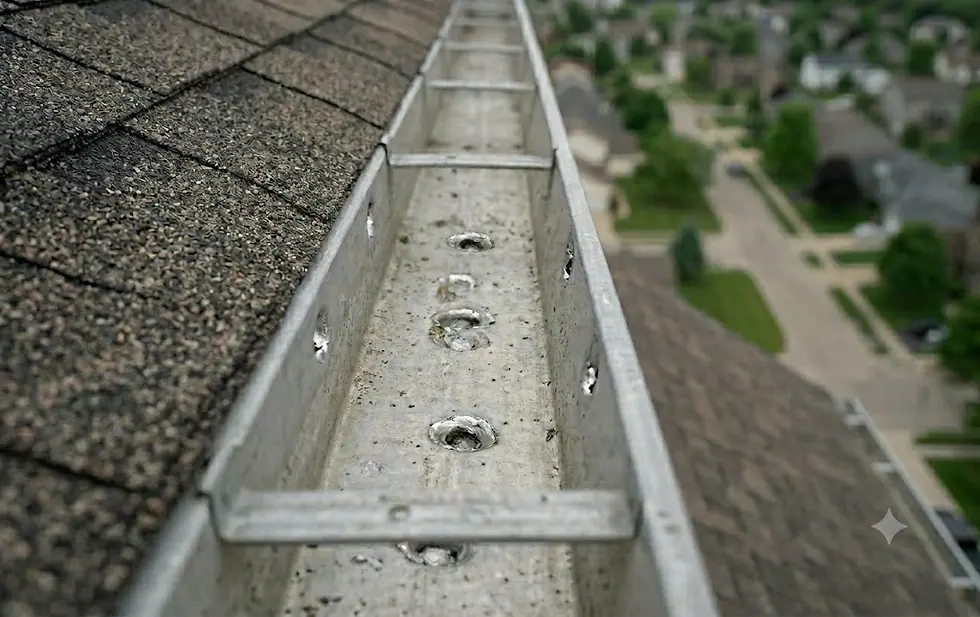
Check your soft metal surfaces next. Look at the condenser fins on your air conditioning unit, your metal roof vents, chimney caps, and painted wood trim around your windows. Circular impact marks or chipped paint on these surfaces almost always mean the roof above them tells the same story. Fresh hail also leaves small craters in flower beds and mulched landscaping that confirm hail size and density. Photograph everything before anything is disturbed.
What hail size actually tells you
Not all hailstones cause the same damage. Three-quarters of an inch, roughly marble-sized, can cause functional damage to asphalt shingles on weathered roofs. Once hail reaches one inch, roughly the size of a quarter, professional inspection is warranted regardless of how the roof looks from the ground. At one and a half inches and above, significant functional damage is very likely even on newer materials.

What hail damage looks like on your shingles
Hail damage rarely looks dramatic from thirty feet below. There is no obvious hole, no missing shingle. What there is instead is a pattern of small, round impact points that are easy to miss if you do not know what you are looking for.
On a standard asphalt shingle, a hailstone impact creates what professionals call a bruise. The stone knocks a cluster of granules loose, exposing the dark asphalt layer beneath. A thorough hail damage roof inspection will find these irregular dark circles or oval patches where the surface texture has changed. Run your hand across a hail-damaged shingle and the bruise feels softer than the surrounding material, because the impact has fractured the fiberglass mat beneath the surface. That mat is the structural backbone of your shingle, and once compromised, the shingle no longer performs as designed.
This distinction between cosmetic damage and functional damage matters most during an insurance claim. The Insurance Institute for Business and Home Safety rates roofing products on a Class 1 through Class 4 impact-resistance scale. Class 4 shingles have passed a steel ball impact test simulating hail of two inches in diameter, and many Texas insurance carriers offer premium discounts for homes with Class 4 rated shingles. If your current roof was replaced in the last several years, check your paperwork to confirm the impact resistance class that was installed.
The damage you cannot see from the ground
There is a category of hail damage that is entirely hidden until it causes a problem, and that problem is almost always a leak months after the storm. When hailstones impact the valleys of a roof and the areas around flashing, pipe boots, and chimney bases, they can crack sealant and flexible materials without leaving any visible mark. A small crack in a valley becomes a reliable entry point every time it rains.
We have seen this pattern consistently across Tarrant and Denton County homes. A storm comes through in April, the homeowner sees nothing alarming, and by August there is a brown stain spreading across a bedroom ceiling. The roof did not fail in August. It failed in April. A professional inspection after any hail event of one inch or greater is the only way to know what you are actually dealing with. For more on how adjusters document this type of damage, see our post on what insurance adjusters look for after a hail storm.

When to call a professional and what to tell them
The purpose of a ground-level inspection is to gather evidence, not reach a conclusion. That final determination requires boots on the roof, moisture probes, and the trained eye of someone who has seen this pattern hundreds of times.
Our threshold for recommending a professional inspection is straightforward. If hail of one inch or larger fell in your area, have a qualified roofer on the roof within seventy-two hours of the storm. If you saw dented gutters, granules in the downspouts, or impact marks on your AC condenser, that threshold drops to three-quarters of an inch. When you make the call, have three pieces of information ready: the date of the storm, the approximate hail size from weather apps or local news, and your ground-level observations. Prompt roof hail damage repair in North Texas is critical — delays of even a few weeks can allow water intrusion to compound the original impact damage.
For homeowners across North Texas who want to get ahead of storm season, our roof maintenance checklist covers pre-season steps worth taking, including a closer look at impact resistant shingles for North Texas homes that can reduce your risk and potentially lower your insurance premium. If you are replacing a roof in the coming years, ask your contractor about Class 4 impact-resistant shingles and visit ibhs.org/hail to review the IBHS rating system. In a county that has recorded 126 severe hail days since 2000, the difference between a standard shingle and a Class 4 shingle is a meaningful long-term investment in one of the most hail-active markets in the country.
Sources and References
Insurance Institute for Business and Home Safety (IBHS) -- Hail Impact-Resistant Shingle Ratings (November 2025) -- https://ibhs.org/hail
Insurance Institute for Business and Home Safety (IBHS) -- compiled from National Weather Service Storm Prediction Center data -- https://ibhs.org
Texas Department of Insurance (TDI) -- Home Insurance Guide -- https://www.tdi.texas.gov/pubs/consumer/cb020.html
Download your Ebook to help protect your home. Pick your county: Denton County, Tarrant County, Wise County, Cooke County, Grayson County

Really enjoyed this article. It was very informative.