Mitigation vs. Restoration: What's the Difference and Why It Matters
Updated: Jun 16

The call comes at 2 in the afternoon. You are at work, your spouse is at the school pickup line, and your neighbor just texted you a photo of water pouring out from under your front door. By the time you pull into the driveway, the living room carpet is saturated and the water has reached the hallway. You call the first restoration company you can find, and within the hour a crew is at your door pulling back carpet and setting up equipment. The project manager tells you they need to mitigate first before any repairs can begin. You nod, but the truth is you have no idea what that means and most North Texas homeowners are in the same position. Understanding the difference between mitigation vs restoration is not just industry vocabulary. It is the difference between a claim that gets paid and a recovery that goes smoothly, and one that does not.
Why North Texas storms create a shorter mitigation window
Here is something most homeowners do not realize until they are standing in the middle of a claim: the restoration industry was not built around North Texas. The standards, the timelines, the general guidance you find online was written for regions where a water loss looks like a water loss. A burst pipe in Minneapolis floods a basement. A roof leak in Seattle soaks an attic. The source is obvious, the path is predictable, and the scope is contained. In North Texas, we deal with something different. Our severe weather does not announce itself neatly. A May storm can drive rain sideways through a window seal that has been fine for fifteen years. A hail event can compromise a roof in a dozen invisible places that will not show up as ceiling stains until October. The loss is real, the damage is real, but the path it took to get there is rarely what the homeowner expected and that gap between what happened and what can be documented is exactly where mitigation and restoration become two very different conversations.
What mitigation actually is
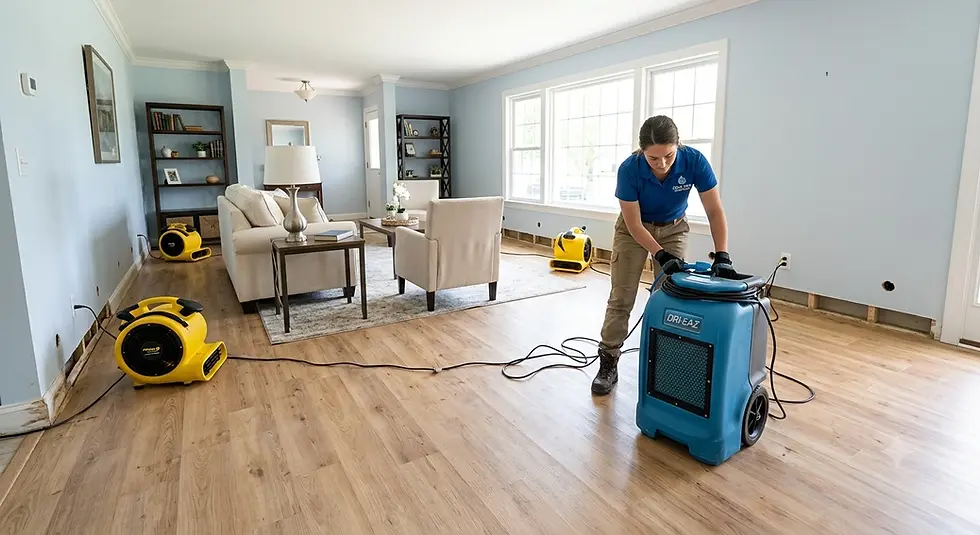
Think of mitigation as the part of the job that stops the bleeding. It is not repair work. It is not reconstruction. It is the trained, documented, equipment-driven process of stabilizing your property so that restoration can eventually begin safely. When a crew arrives and starts pulling carpet, drilling holes in baseboards, and setting up machines that run around the clock, that is mitigation. The goal is not to make your home look better. The goal is to make it stop getting worse.
The S500 standard breaks this phase into three core actions: extraction, evaporation, and dehumidification. Extraction removes standing water using truck-mounted or portable units capable of pulling hundreds of gallons from flooring systems in a single pass. Evaporation converts moisture trapped inside walls, subfloors, and framing into vapor using high-velocity air movers positioned at precise angles based on material type and saturation level. Dehumidification captures that vapor before it can resettle into dry materials nearby, using commercial-grade low grain refrigerant units that bear no resemblance to the dehumidifier in your garage. These three steps work as a system. Running only one or two of them is like trying to empty a bathtub with the drain plugged. The technician operating the equipment holds industry certifications requiring rigorous testing administered by the IICRC. A Water Restoration Technician designation confirms a working knowledge of psychrometrics and moisture behavior inside building assemblies. An Applied Structural Drying certification covers the mechanics of drying dense materials like hardwood and multi-layer subfloor systems where moisture hides long after the surface feels dry to the touch. What ties all of it together is documentation. Moisture readings are taken before a single machine is placed, logged daily, mapped onto a floor plan, and compiled into a report that speaks the same language your insurance adjuster uses. That report is not a formality. It is the foundation of your claim.

What restoration actually is
Restoration is the phase most homeowners are actually picturing when they make that first phone call. New drywall. Fresh paint. Flooring that does not squeak. It is the rebuild, and it cannot begin until mitigation is fully complete and verified by data, not by appearance or feel. A wall can look perfectly fine and still be holding moisture content well above the threshold where mold will grow. Any materials installed over unresolved moisture become part of the problem rather than the solution, and the damage that follows is almost always more expensive than the repair that was rushed. When the dry standard is reached and documented, restoration can begin with confidence. The scope depends entirely on what the mitigation process revealed: sometimes cosmetic, sometimes structural, sometimes the rebuilding of entire rooms. A qualified restoration project manager will walk you through what needs to happen, in what order, and why, so that nothing is done twice and nothing is left out of your claim submission. If you are still dealing with the question of what to do in the first 24 hours after water damage, that post covers the immediate steps before any crew arrives.
Why the sequence matters
The relationship between mitigation and restoration is not flexible. One must be complete before the other can begin, and both need to be managed by people who understand how insurance documentation works. We worked with a client named Jim in North Fort Worth who learned this the hard way. After a water loss at his home, Jim had a family friend in the contracting business handle the restoration scope and put together the submission to the insurance company. It seemed like a reasonable plan. His contractor knew construction, but he did not know how to justify each line item the way an adjuster expects to see it documented. Several necessary repair items were left out of the scope entirely. Others were included but without the supporting documentation required to back them up. When the submission went in, significant portions of the claim were denied, not because the work was unnecessary, but because the paperwork did not speak the language adjusters use to evaluate it. Jim eventually got his home restored, but the path there was longer and more stressful than it needed to be. Restoration documentation is its own discipline, and it requires someone who does it every day.
What this means for your insurance claim
Most standard homeowners policies cover both mitigation and restoration when the cause of loss is sudden and accidental. What many homeowners do not realize is that these two phases are typically billed and reviewed separately by your adjuster. Mitigation scopes are evaluated against field data: moisture readings, drying logs, equipment records, and atmospheric conditions. Restoration scopes are compared against the documented damage and the pricing software adjusters use internally, most commonly Xactimate. Line items tied to confirmed damage with supporting documentation move through efficiently. Line items that appear without context are the ones that slow a claim down or trigger a denial.
The one question worth asking before work begins
Before any contractor touches your property, ask them directly whether they are familiar with Xactimate and whether they have experience submitting restoration scopes to residential carriers. A yes to both means they understand the system your adjuster operates inside. Your restoration project manager should be able to answer both questions without pausing. For a deeper look at what separates a professional restoration company from a general contractor, see our post on choosing a restoration company in North Texas.
Working the process from the start
The homeowners who come out of a water loss in the best position are almost never the ones who moved the fastest. They are the ones who understood what phase they were in, asked the right questions, and kept the right people involved from the beginning. If you have water in your home right now, your first call should be to a certified restoration company. Get mitigation started immediately, let the drying process run its full course, and do not allow restoration work to begin until the data confirms the structure is ready. When you reach the restoration phase, stay involved. Review the scope with your project manager line by line and make sure the submission reflects everything the loss actually requires. Cutting corners at either phase does not save time or money. It transfers the cost forward into a harder recovery, a reduced settlement, or both. One of the most common mistakes we see during mitigation is homeowners running household fans instead of professional drying equipment — it feels productive but it delays the process and risks secondary damage.

Frequently Asked Questions
What is the difference between mitigation and restoration?
Mitigation is the emergency stabilization phase that happens immediately after a water loss. The goal is to stop active damage, extract standing water, dry the structure, and document conditions before anything gets worse. Restoration is the repair and rebuild phase that follows once mitigation is fully complete and verified. New drywall, flooring, paint, and structural repairs all belong to restoration. The two phases serve different purposes, follow different timelines, and are typically reviewed separately by your insurance adjuster.
Can I skip mitigation and go straight to restoration?
No, and attempting to do so almost always makes the situation worse. Restoration work installed over materials that have not been properly dried will trap moisture inside the building assembly. That moisture continues to damage the structure from the inside and creates the conditions mold needs to grow. Beyond the physical consequences, skipping or shortcutting mitigation also weakens your insurance claim. Adjusters expect to see a documented mitigation phase before restoration begins. Without it, the entire scope of your loss becomes harder to justify.
How long does mitigation take before restoration can begin?
Most residential mitigation jobs run between three and five days, though the timeline depends entirely on what the moisture data shows, not on how the surface looks or feels. A certified technician monitors readings daily and the drying process is considered complete only when every affected material reaches the established dry standard for that structure. Rushing that timeline to get to repairs faster is one of the most common and costly mistakes homeowners make during a water loss recovery.
Will my insurance cover both mitigation and restoration?
Most standard homeowners policies cover both phases when the cause of loss is sudden and accidental. Coverage for each phase is evaluated separately, and both require proper documentation to be approved as submitted. Mitigation scopes are reviewed against field data including moisture readings and equipment logs. Restoration scopes are compared against documented damage and industry pricing standards. Working with a restoration company whose project managers have direct experience submitting scopes to residential carriers gives you the best chance of a clean, fully supported claim from start to finish.
Sources and References
ANSI/IICRC S500 Standard for Professional Water Damage Restoration (5th ed., 2021) — https://www.iicrc.org/standards
Xactimate / Xactware (Verisk) — https://www.verisk.com
Download your free homeowner preparedness guide for your county:


Comments