Can Bleach Kill Mold on Drywall?
Updated: Aug 21
Bleach can kill mold on the surface of drywall, but it cannot reach the mold's root network embedded inside the porous material underneath, so the mold typically returns within one to two weeks, often worse than before. That gap between what bleach appears to do and what it actually does is why it's one of the most common, and most expensive, mistakes homeowners make, and why one North Texas homeowner's five-day bleach routine ended up costing him four times his original estimate.
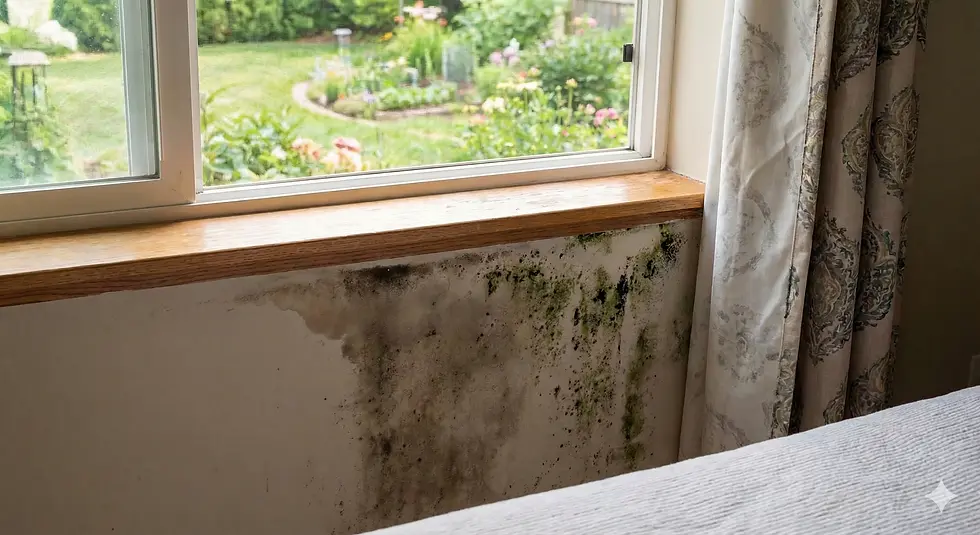
If you have ever walked into a room and noticed fuzzy black growth on your baseboards or a dark stain slowly spreading across your drywall, your first thought is probably: can you kill mold with bleach? You pull out the gallon, grab a scrub brush and a bucket, and feel like you are about to solve the whole problem for about five dollars. It seems to make perfect sense. Bleach is what most people reach for to disinfect a countertop or whiten a load of socks.
As restoration professionals who deal with this every single day, we have to tell you the truth. Applying bleach to mold on a porous surface is like trying to put out a fire with gasoline. We see the results of the bleach fix week after week. Homeowners think they have won the battle because the black spots disappear for a few days. Then they call us two weeks later when the mold comes back twice as thick and the air in the house smells like a chemical swamp.
Why bleach fails on porous materials
Materials in your house fall into three basic categories: non-porous, semi-porous, and porous. Non-porous materials are things like glass, metal, and sealed stone. Semi-porous materials include some hardwoods and concrete. Porous materials are your drywall, insulation, carpet padding, and unsealed wood, the same materials most vulnerable to mold growth after water damage.
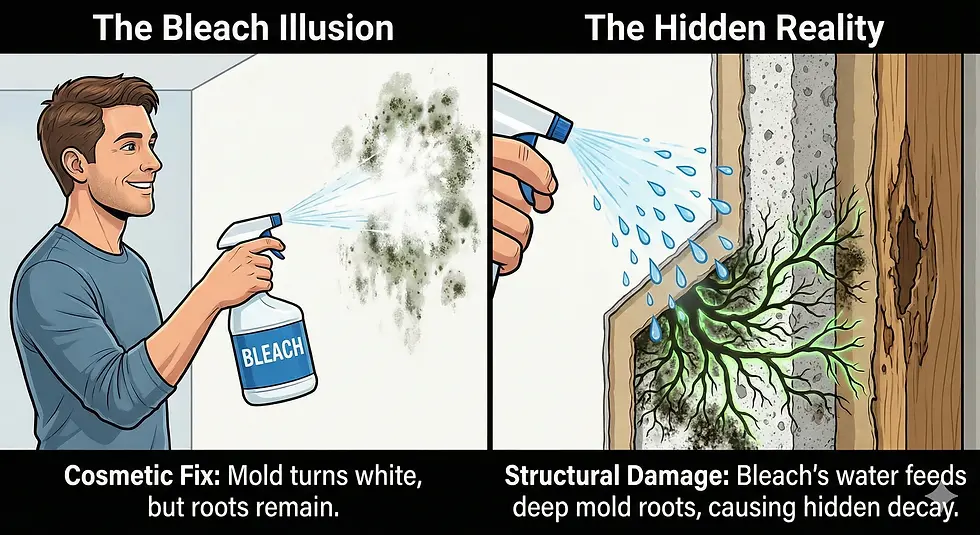
If you spill grape juice on a glass table, the juice stays right on the surface, and wiping it away removes it completely. That is exactly how bleach works on a non-porous surface. But your walls and subfloors are not like glass. They are more like a hard sponge. When you spray bleach on drywall, the chlorine, which is the part that actually kills the mold, cannot soak deep into the material. It stays on the surface, stripping the color away, while the liquid part of the bleach, mostly water, gets pulled straight into the fibers. You have bleached the visible part of the mold while giving its hidden roots a fresh drink of water.
Mold grows through a network of microscopic filaments called hyphae that anchor deep into the material underneath, not just as a stain sitting on the surface of your wall. Think of mold like a weed in your garden: snip off the green leaves but leave the root system in the dirt, and the weed grows back, usually stronger than before. According to IICRC principles, when contamination is embedded in a porous material, simply cleaning the surface is rarely enough. In most cases that material is considered Category 2 or Category 3 contaminated and needs to be physically removed, not just wiped down.
The cosmetic trick: why the mold looks gone
Most household bleach is roughly 90 to 95 percent water. When you saturate a moldy wall with bleach, the chlorine evaporates very quickly, which is why you get that strong, stinging smell right away. Once the chlorine has gassed off, what is left behind is mostly water, introducing a fresh supply of moisture directly into the mold's food source. Since moisture control is the number one rule of mold remediation, using a water-based cleaner to solve a moisture-based problem is a fundamental contradiction. You may have killed the surface spores, but you have just irrigated the root system that survived deep inside the drywall.

Bleach is a powerful oxidizer that strips the pigment out of mold, so within minutes that scary black patch turns white or clear. The homeowner sees this and stops looking for the source of the leak, stops running fans, sometimes paints right over the spot. But the mold is still there, just impossible to see. Because the roots are still alive and now have a fresh supply of water, they begin to grow again almost immediately, often deeper and more widespread within a week or two.
How much bleach do you need to kill mold?
There is no reliable consumer bleach-to-water ratio for killing mold, and that is worth understanding rather than guessing at. The dilution ratios that circulate online for household cleaning were designed for surface disinfection, not for penetrating and eliminating an embedded mold colony in porous material. Professional remediation uses EPA-registered antimicrobials tested and formulated at specific concentrations for mold specifically, something no consumer bleach product is validated to do. A stronger mix does not solve the porosity problem covered above, and it increases the health risk covered below. If a number is what you are looking for, the honest answer is that the right number depends on the material, the extent of contamination, and equipment a homeowner typically does not have on hand, which is exactly why this is professional remediation work rather than a DIY measurement.
The physical risks of using bleach indoors
Beyond the mold itself, dumping gallons of bleach into an enclosed, damp space carries real physical danger. Spraying bleach in a bathroom or basement with poor ventilation releases high concentrations of chlorine gas, and in a humid environment this off-gassing is more intense and lingers longer. We have walked into homes where the homeowner was wearing a simple dust mask, which does nothing for chemical vapors, while saturating their walls with bleach, later complaining of stinging eyes, a scratchy throat, or a heavy chest. If that bleach happens to mix with any other household cleaner containing ammonia, common in many glass and floor cleaners, it creates chloramine gas, which can be deadly.
Bleach is also chemically aggressive on the materials themselves. On wood, it breaks down lignin, the glue that holds wood fibers together, making wood fuzzy, brittle, and structurally weak over time. On drywall, the paper backing is made of cellulose, mold's favorite food, and hitting that paper with bleach degrades the cellulose fibers while re-wetting them at the same time. We have seen drywall bleached so many times it practically turned to mush when touched with a moisture probe. Repeated bleaching does more than clean the wall's surface; it erodes the material underneath it.
What the IICRC S520 standard says
In the restoration industry, we follow the IICRC S520 standard for professional mold remediation. Its stance on bleach is clear: biocides like bleach are not a substitute for proper remediation. The primary goal of mold remediation is physical removal of the mold and the source of moisture, not just changing its color, because dead mold spores can be just as allergenic as live ones. Bleaching the visible mold while leaving the physical structure of dead spores embedded in the wall does not solve the indoor air quality issue.

A North Texas case in point
A client in Gainesville, a maintenance engineer, thought he could out-think the problem after a leak affected a large area of carpet and drywall. Instead of hiring us for the full dry-out, he brought home commercial-grade fans and ran them for five days, scrubbing the baseboards with bleach every morning. When we arrived to verify dryness for the insurance company, the smell hit us before anything else. The carpet felt dry to the touch, but underneath, the padding was soaked. The moisture had wicked six inches up into the drywall behind the baseboards, and the walls he had been bleaching showed faint ghosting where mold was thriving in the dark, wet cavity behind the gypsum. What started as a simple three-day dry-out became a full remediation project requiring containment, HEPA air scrubbers, and tearing out drywall throughout the room. His DIY approach ended up costing four times the original estimate.
What actually works: professional remediation
Professional remediation, not bleach, is what actually solves the problem, and it relies on three pillars. First, mechanical removal: HEPA-filtered vacuums, sanding, and sometimes dry-ice blasting physically remove the mold and its root system from semi-porous materials; if it is truly porous, like drywall, we cut it out. Second, EPA-registered antimicrobials, not bleach, penetrate surfaces and provide a residual shield that prevents new spores from landing and growing. Third, HEPA filtration cycles the room's air through medical-grade filters to catch spores stirred up during cleaning.
When to call a professional
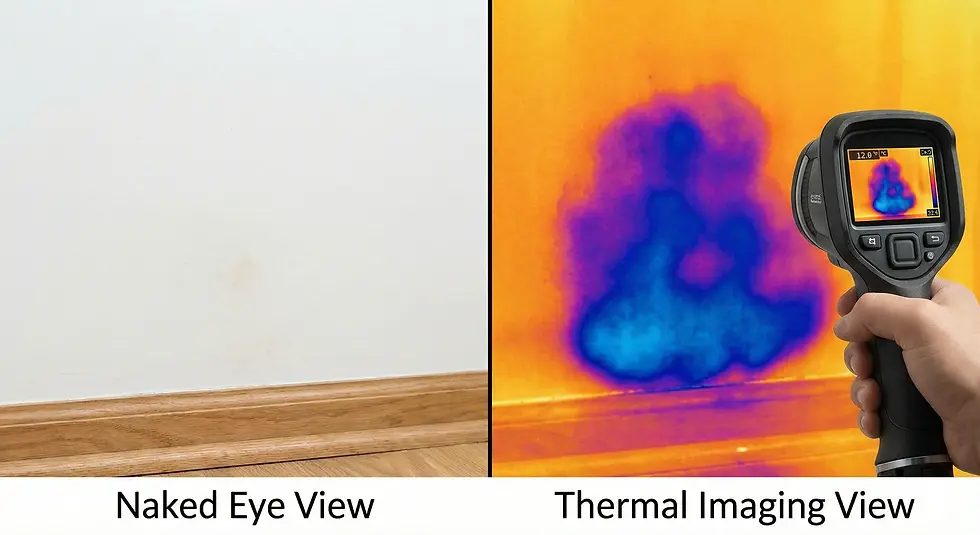
If you see mold in your home, put the bleach back in the laundry room. Whether drying worked comes down to what the moisture data says, not how a surface feels to the touch. Without a moisture meter, a thermal camera, and professional-grade equipment, you are guessing, and in the world of mold, guessing usually leads to a much bigger bill down the road. For professional mold removal in North Texas, call a certified firm that follows IICRC standards. They do not just hide the problem. They remove it, dry the structure, and confirm your air is safe to breathe again.
Key takeaways
Bleach kills mold on the surface of porous materials like drywall but cannot reach the root network embedded underneath, so the mold typically returns within one to two weeks.
There is no reliable consumer bleach-to-water ratio for killing mold. Professional remediation uses EPA-registered antimicrobials formulated for mold specifically, not household bleach.
Bleaching a porous surface adds moisture exactly where mold needs it most, and repeated bleaching breaks down the structural integrity of wood and drywall over time.
Mixing bleach with ammonia-based cleaners produces chloramine gas, which can be dangerous in an enclosed space.
The IICRC S520 standard calls for physical removal of mold and its moisture source, not surface disinfection, as the goal of remediation.
FAQ
How much bleach do I need to kill mold on drywall?
There is no reliable consumer ratio for this, since household bleach dilutions were designed for surface disinfection, not for penetrating porous material where mold's roots live. Professional remediation uses EPA-registered antimicrobials tested at specific concentrations for mold instead.
Can bleach kill mold on walls permanently?
No. Bleach kills the surface spores and strips their color, but it cannot reach mold's root network inside porous drywall or wood, so the mold typically regrows within one to two weeks, often worse than before.
Is it safe to use bleach on mold indoors?
Bleach releases chlorine gas that can irritate eyes, throat, and lungs, especially in an enclosed or poorly ventilated space, and mixing it with ammonia-based cleaners creates dangerous chloramine gas. A dust mask does not protect against these vapors.
Should I use bleach or hire a professional for mold?
For mold on non-porous surfaces like glass or sealed tile, bleach can work. For mold on drywall, wood, or other porous materials, professional remediation using mechanical removal and EPA-registered antimicrobials is the only approach that addresses the root cause rather than the surface stain.
Sources and references
ANSI/IICRC S520 (2024) — Standard for Professional Mold Remediation: https://www.iicrc.org/standards
U.S. EPA — Mold Guidance: https://www.epa.gov/mold
Download your free homeowner preparedness guide for your county: Tarrant County | Denton County | Wise County | Cooke County | Grayson County
Comments