Beyond the Smell: The Science of Cleaning Smoke Damaged Belongings
Updated: May 21
The Truth About Smoke Damaged Laundry and Walls
Once the fire trucks leave and the immediate shock wears off, fire damage restoration becomes the most pressing challenge you face. You are left standing in a house full of belongings that used to feel safe and familiar. Now, everything from your favorite sweater to your bedroom walls is coated in a strange, often sticky residue and carries that unmistakable, acrid odor of smoke. If the smoke was "black smoke" from burning plastics or electronics, the soot is likely embedded in every porous material. The most urgent impulse is to start cleaning immediately. You want to throw loads of laundry into the washing machine and start scrubbing walls just to feel like you are making progress. While this instinct is understandable, professional restoration standards define a very different approach to ensuring your home and items are truly decontaminated.

The first major hurdle homeowners face is their textiles. It seems logical that if your clothes, sheets, and towels smell smoky, a heavy duty wash cycle with extra detergent should fix it. According to the IICRC S700 standard, however, standard household laundering is often insufficient for smoke damage. Regular detergents are formulated to break down organic soils like body oils and dirt. They are not designed to tackle the complex, often acidic chemical residues created by burning plastics, synthetics, and building materials. Even if your clothes come out of the dryer smelling fresh, microscopic soot particles can remain trapped deep in the fabric weave. Wearing these items against your skin can lead to irritation known as dermatitis or allow traces of toxins to be absorbed into your body. For anything beyond very light exposure, professional restoration laundering using specialized surfactants and deodorizing chambers is necessary to break down those chemical bonds completely.
Source Removal on Structural Surfaces
The same principle applies to the structure of your home itself. A common question on forums is how to simply treat the smoke smell on furniture and walls. The hard truth of professional restoration is that you cannot treat an odor without first removing its source. Trying to deodorize a room that still has soot on the walls is like trying to dry off while still standing in the shower. The IICRC emphasizes source removal as the critical first step.
For hard surfaces like walls and ceilings, this means more than a quick wipe down. The acidic residue must be physically lifted using heavy duty degreasers, which can cut through the oily soot that water alone will just smear around.
Even after this intensive cleaning, the porous nature of drywall means that some microscopic odor particles may remain embedded in the surface. Therefore, the professional standard often requires applying a specialized smoke sealing primer, usually an oil based or shellac based product, to permanently lock those remaining odors into the wall before any cosmetic painting is done. If you skip the cleaning and sealing steps and just paint over the smoke damage, you will almost certainly find the odor bleeding back through the new paint within weeks or months.
The Porosity Problem of Mattresses and Couches
When a fire occurs, the most distressing decisions often involve the items we sleep on or sit on every day. Many homeowners ask if a smoky mattress can be saved with a professional ozone treatment. To understand the answer, we have to look at how the IICRC S700 defines porous materials. A mattress is essentially a giant, thick filter. During a fire, the combination of heat and pressure drives microscopic smoke particulates deep into the foam, batting, and internal springs.
While ozone is a powerful oxidant that is excellent at breaking down odor molecules on a surface level, it simply cannot penetrate to the dense core of a mattress to neutralize every trapped toxin. Because you spend eight hours a day with your face pressed against this material, the professional "Standard of Care" usually classifies heavily exposed mattresses as non-restorable. The risk of the mattress "off-gassing" deep-seated chemical residues into your breathing zone while you sleep is considered too high. In the world of professional restoration, your long term respiratory health outweighs the cost of a new mattress.

Deciding Between Restoration and Replacement
The decision to keep or toss a couch or a set of pillows follows a similar logic based on porosity and the ability to verify that the item is truly clean. Pillows are almost always recommended for replacement. Like mattresses, they trap soot internally, and because they are relatively inexpensive compared to the cost of industrial cleaning, the safest route is to discard them.
Couches, however, fall into a gray area depending on their construction. If you have a non-porous leather or protected vinyl sofa, a professional can often degrease and deodorize it successfully. But for fabric or microfiber couches, the situation is more complex. The IICRC notes that if the smoke was "black smoke" from burning plastics or electronics, the soot is likely embedded in the foam cushions. Often, the cost to strip a couch down to its frame and replace all the internal foam and external fabric is more expensive than buying a new one. If a professional cannot guarantee that the deep internal reservoir of toxins has been removed, the recommendation will always lean toward replacement to ensure your living environment is chemically safe.
Electronics and the Myth of Home Remedies
In our modern homes, electronics are often the most expensive items we own, and they are uniquely vulnerable to smoke. A common misconception is that if a television or computer powers on after a fire, it has escaped damage. However, the IICRC S700 warns that smoke from synthetic materials is often highly acidic. When this soot settles inside a device, it sits on the delicate metal traces of circuit boards.
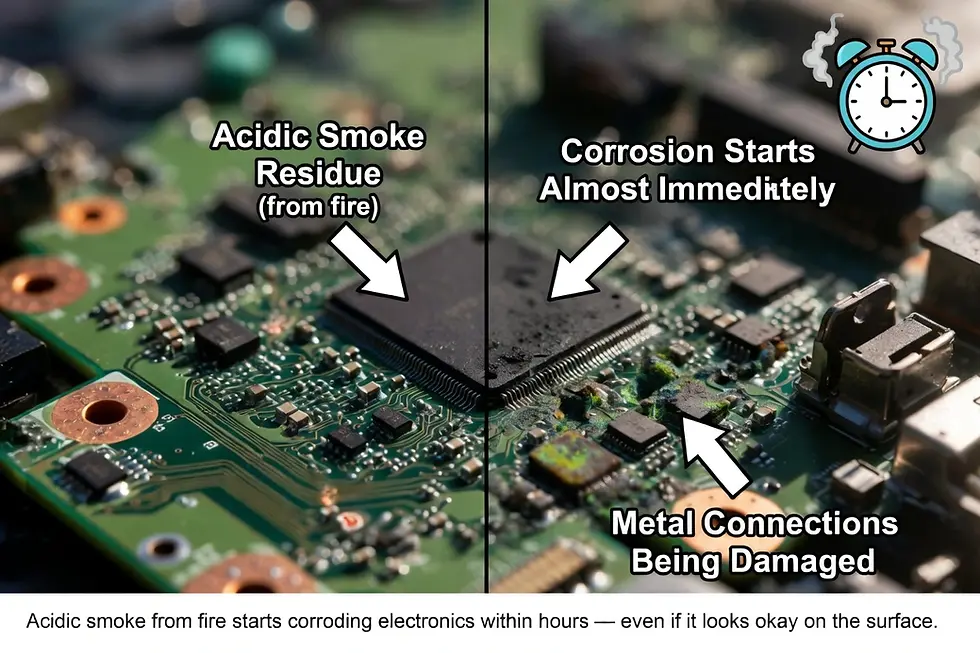
Over time, these acids eat away at the metal, leading to a "ticking clock" of failure. Furthermore, soot is carbon-based and can be conductive; if enough of it accumulates, it can cause a short circuit the next time the device is used. The professional standard dictates that electronics should be opened and cleaned with specialized, non-conductive cleaners before being put back into service. Saving a thousand-dollar laptop often comes down to removing that internal reservoir of soot before the corrosion sets in permanently.
The Limits of Vinegar and Baking Soda
When homeowners search for ways to remove stubborn smoke odors, they often find "hacks" involving vinegar or baking soda. While these are great for everyday household smells, they are largely ineffective against structural fire damage. Vinegar is an acid that can cut through some surface oils, but it cannot neutralize the complex, deep-seated toxins found in synthetic "Black Smoke." Similarly, baking soda can absorb some surface moisture and light odors from a rug, but it cannot reach the smoke particles driven inches deep into a sofa's padding.
Effective smoke damage restoration follows a strict professional hierarchy. First, technicians physically remove the source through degreasing. Second, they use equipment like thermal foggers or hydroxyl generators. These machines create a "fog" or a gas with particles the same size as the original smoke, allowing the neutralizer to penetrate the exact same pores that the smoke did. Finally, if an odor still lingers in the wooden "skeleton" of the house, the IICRC recommends using an odor-blocking sealer. This multi-step process is the only way to ensure the smell doesn't return on a hot, humid day.

Personal Protection and Safety Boundaries
When you are dealing with the aftermath of a fire, the environment itself is a collection of hazards. The IICRC S700 standard is very clear that the restorer's first priority must be the safety of the people inside the structure. If you are entering your home to begin sorting through your belongings before a professional crew arrives, you must treat the space as a hazardous materials site.
Standard dust masks from a hardware store are simply not enough to protect your lungs from fire residues. Professionals recommend using a respirator that prevents the ultra-fine soot particles that are small enough to lodge deep in your respiratory system. Additionally, you should protect your skin with long sleeves, pants, and nitrile gloves. Because soot is often acidic and contains concentrated toxins, it can be absorbed through the skin or cause rashes. Finally, be mindful of cross-contamination. Walking through a soot-covered room and then into a clean "safe zone" or your car carries those toxins with you. Use "sticky mats" at the exits and change your outer clothing before leaving the affected area to keep the contamination contained.
Understanding the Limits of Restoration Standards
While the IICRC provides the "gold standard" for how to physically clean and decontaminate a home, it is important to understand what these rules do not cover. Restoration is a technical science, but recovery is also a financial and legal process. There are several questions that the IICRC cannot answer because they fall into different professional categories.
For instance, whether your insurance company is required to pay for a brand-new mattress or if they will only cover the cost of a cleaning attempt is a matter of your specific policy and the laws in your state. Similarly, the long-term health impact of smoke exposure is a medical question that should only be addressed by a doctor or a toxicologist. If you are a tenant, the legal requirement for a landlord to provide alternative housing during the cleaning process is governed by local housing laws and your lease agreement. By hiring a fire damage restoration company in North Texas that follows the scientific protocols of the IICRC for the physical work, and consulting with adjusters, doctors, or legal experts for the rest, you can ensure a comprehensive and safe recovery.
Restoration vs. Replacement: The IICRC Cheat Sheet
Item Type | Restorable? | Key Reason |
Glass & Metal | Yes | Non-porous; soot sits on the surface and can be degreased. |
Hardwood Furniture | Often | Semi-porous; can be cleaned and resealed if not heat-damaged. |
Electronics | Conditional | Requires internal cleaning to stop acidic corrosion. |
Clothing & Linens | Conditional | Needs professional restoration laundry, not a home washer. |
Mattresses | Rarely | Deep porosity; traps toxins where you breathe for 8 hours. |
Bed Pillows | No | Inexpensive to replace; acts as a primary filter for soot. |
Upholstered Couches | Case-by-Case | Synthetic "Black Smoke" usually permanently taints internal foam |
What to Do While You Wait
Don't "Test" Electronics: Keep them unplugged to prevent short circuits from conductive soot.
Separate the Laundry: Do not mix smoke-damaged clothes with clean ones; you will cross-contaminate your washing machine.
Seal the Vents: If the HVAC isn't running, cover registers with plastic to prevent soot from settling into the ductwork.
Avoid DIY Chemicals: Mixing household cleaners with acidic soot can sometimes create unintended chemical reactions or staining.
Download your E-book to help protect your home. Pick your county: Denton County, Tarrant County, Wise County, Cooke County, Grayson County


Comments